
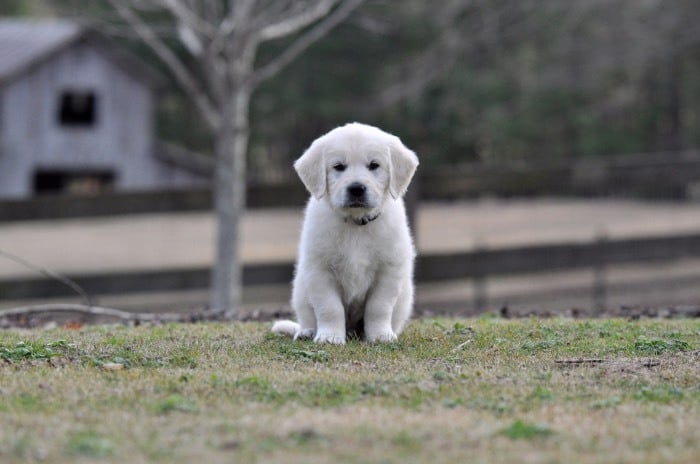
If you're nursing a few scratches and quietly wondering whether something's wrong with your sweet puppy — nothing is. Those needle-sharp teeth, and the nipping that comes with them, are one of the most normal, predictable parts of puppyhood. It isn't aggression, and it doesn't last. With the right, gentle approach, you can teach your puppy to use their mouth softly, and enjoy this stage instead of bracing through it.
We're a small, family-run program, and we've watched every one of our litters move through this exact phase. Here's the most reassuring thing we can tell you: puppies explore the entire world with their mouths, and learning to control those mouths is a skill — one they pick up gradually, with your help. The goal isn't to punish the biting out of them. It's to teach a soft mouth, redirect those needle teeth onto the right things, and quietly meet the needs that set off the worst of it. It's the same gentle, reward-based approach we use with every English Cream Golden Retriever we raise.
What's NormalWhy your puppy is biting
Here's the reframe that changes everything: mouthing is how puppies investigate the world. With no hands of their own, they explore textures, test boundaries, and play the only way they know how — with their teeth. When your puppy clamps onto your fingers, they aren't being aggressive or dominant. They're being a puppy.
Two things make the weeks between roughly eight and sixteen especially nippy. The first is plain curiosity and play, which peaks right as your puppy is settling into your home. The second is teething: those baby teeth start loosening and adult teeth push through over the months that follow, and chewing brings real relief to sore gums.
Most importantly, your puppy is learning a skill called bite inhibition — how to control the pressure of their jaws. In the litter, they learned the first lessons from their siblings: bite a littermate too hard, and the game stops. Your job now is to continue that lesson. And here's the part most advice skips — the first goal isn't a puppy who never mouths at all. It's a puppy with a soft, gentle mouth. Teach the softness first, and the frequency fades right behind it.
The MethodRedirect, and teach a soft mouth
The whole method rests on one simple idea: make the right thing to chew more rewarding than your hand.
Keep a soft toy or chew within reach in the rooms where you spend time. The moment your puppy starts to mouth your fingers, calmly offer the toy instead — a gentle trade. When they take it, that's the win; let them chew and tug to their heart's content. Over and over, you're teaching the same lesson: teeth belong on toys, and toys are wonderful.
When a bite does land on skin — and it will — let the fun stop. A calm, quiet pause does more than any sharp reaction: ease your hand away, end the game for a moment, and go still. You're showing your puppy exactly what their littermates showed them — bite too hard, and the good times pause. Wait a beat, then re-engage with a toy. No scolding, no drama; the lull itself is the message.
You may have heard the advice to yelp loudly when your puppy bites. For some puppies it works — but for plenty of excitable Goldens, a high-pitched squeal is thrilling, and it winds them up even more. If your puppy gets more bitey when you react, skip the noise. A calm, boring pause is the version that works for almost every pup.
Reward the mouth you want to see, too. When your puppy licks instead of nips, takes a treat gently, or chews their own toy beside you, a soft word and a piece of their kibble tells them they've got it right. We lean on the same gentle, food-rewarded approach for all of it — here's how we think about treating.
The Root CauseMeet the need behind the bite
If your puppy turns into a little land shark at the same time every evening, the cause usually isn't naughtiness — it's exhaustion. This is the single most overlooked piece of the puzzle. An overtired puppy, much like an overtired toddler, gets wired, frantic, and very, very bitey.
Puppies need eighteen to twenty hours of sleep a day.
An overtired puppy is a bitey puppy. If the nipping spikes in the evening, the answer is usually a nap, not a correction — settle them for a quiet rest and watch the "witching hour" soften.
The fix is often as simple as a nap. When the biting ramps up and your puppy can't seem to settle, a quiet hour of enforced rest in the crate or pen works wonders — many families are amazed to find the evening crazies melt away once their puppy is finally sleeping enough. Hunger and pent-up energy play their part too, so a fed puppy with a real outlet for play tends to be a gentler one.
Then give those needs somewhere to go. A basket of varied chew toys, a frozen wet washcloth or rubber toy for sore teething gums, a flirt pole or a game of tug for the wild energy — these all give your puppy the right way to do what their body is already asking for. Meet the need, and you remove the reason for half the biting before it ever starts.
What to AvoidWhat makes biting worse
A few well-meant habits quietly make biting harder to solve, so they're worth naming.
The big one is punishment. Holding your puppy's mouth shut, scruffing, "alpha rolling," or smacking a nose doesn't teach a soft mouth — it teaches fear, ramps up arousal, and can turn playful mouthing into something more defensive. It also chips away at the trust you're working to build. Reward-based redirection is gentler, and it genuinely works faster.
Be careful, too, not to turn your own hands and feet into toys. Wiggling fingers, shoving a puppy's face during play, or letting them gnaw on you "just this once" all teach that skin is fair game — a confusing message when you're trying to teach the opposite. Keep a toy between your hands and those teeth.
Children make this trickier, because quick movements and high voices are exactly what spark a puppy to chase and nip. Supervise every interaction, teach kids to "be a tree" and go still rather than run, and use a gate or pen to give everyone a break when play gets too wild.
With consistent, gentle redirection, most puppies grow noticeably softer-mouthed by five or six months, as bite inhibition sets in and teething winds down. It's a phase, and it passes. If your puppy's biting ever seems truly fearful rather than playful — a stiff body, hard stares, or growling outside of play — reach out to a force-free trainer or your veterinarian for a closer look. For ordinary puppy mouthing, though, patience and the right outlets are all it takes.
Bringing home a puppy this year?
Every puppy we raise is handled gently from day one, surrounded by littermates who teach those first lessons in a soft mouth — so they come home already learning the skills above. We have an English Cream litter on the way and our waitlist is open now, with health-tested, AKC-registered parents and puppies raised right in our home.
Join the waitlistAmerican Veterinary Society of Animal Behavior (AVSAB) — position statements on reward-based training and the case against aversive, punishment-based methods.
American Kennel Club & The Humane Society of the United States — guidance on normal puppy mouthing, teaching bite inhibition, and redirection (2025–2026).
VCA Animal Hospitals & ASPCA — puppy teething, mouthing as normal development, and managing nipping without punishment.
This article is general guidance from our experience as breeders, not a substitute for professional behavior or veterinary advice. If your puppy's biting seems fearful rather than playful, check in with a force-free trainer or your veterinarian.
%20(1).jpg?width=1082&height=866&name=20260609_162027(0)%20(1).jpg)
.webp?width=1920&height=1047&name=golden-1128-P5-2%20(1).webp)