
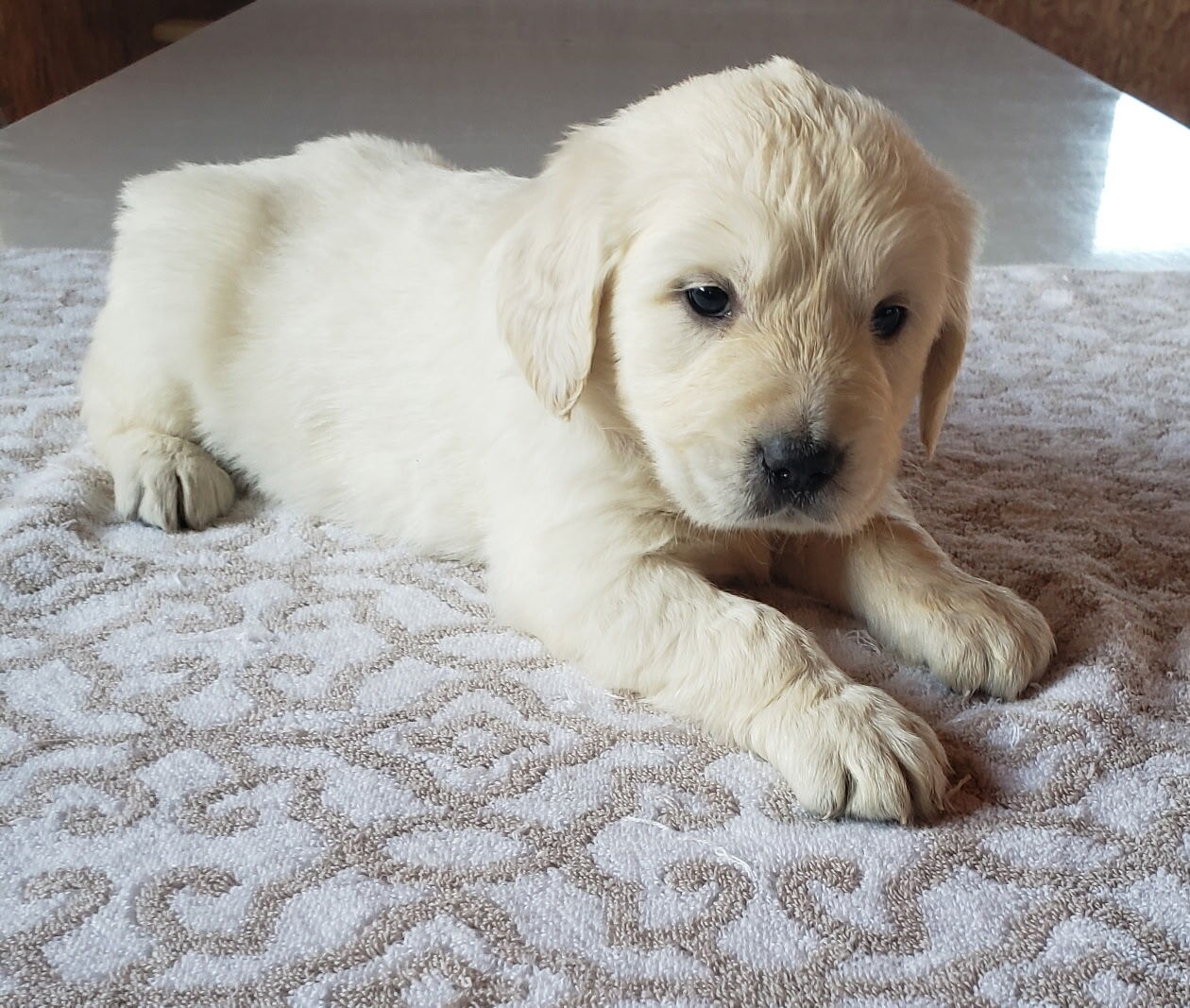
You're picturing the easy part — the puppy who trots to the back door and waits, the clean floors, the quiet nights. Getting there isn't about catching mistakes or correcting them. It's about building a simple rhythm that makes the right choice the easy choice, so accidents stay rare from the very start.
We're a small, family-run program, and house-training — most people call it potty training — begins long before a puppy ever joins your family. By eight weeks, our litters are already used to leaving their sleeping space to potty and following a predictable daily routine. That head start is real, but the habit only sticks if the rhythm continues in your home. The good news: the method is gentle, forgiving, and the same reward-based approach we use with every English Cream Golden Retriever we raise. Here's exactly how to carry it home.
The FoundationThe foundation: prevent, don't correct
House-training works the moment you stop thinking about accidents and start thinking about opportunities. Every time your puppy potties in the right place, the habit gets a little stronger. Every accident on the rug quietly teaches the opposite. So the whole game is simple: make the right spot easy to reach, and be there to reward it. That comes down to two things — a rhythm and your attention.
The rhythm is predictable. Puppies almost always need to go right after they wake up, within a few minutes of eating or drinking, and after a burst of play. Build those moments into your day and you'll catch most of them before the urge ever arrives indoors. In between, offer a trip outside on a regular cadence rather than waiting for a signal.
About one hour per month of age — and that's the most they can hold.
A two-month-old puppy can manage roughly two hours; a four-month-old, about four. Treat it as a ceiling, not a schedule — head outside well before you reach it, and accidents stay rare. Overnight and during big growth spurts, you'll need to go even sooner.
Your attention covers the rest. A young puppy should be either actively watched or comfortably contained — never loose and unsupervised in another room, where a mistake can happen unseen. When you can't keep eyes on them, that's exactly what the crate or a small pen is for. Learn the tells, too: sudden sniffing, circling, or drifting away from play usually means now, so scoop them up and head for the door.
After a meal or a nap, you often have only a few minutes before a puppy needs to go. Make those trips automatic — out the same door, to the same spot, every single time. Predictability is what makes the lesson land.
The RewardReward the right spot, every time
Here's where the habit is truly made — and where most house-training stalls. The reward has to land in the right place, at the right second.
When your puppy finishes outside, mark it right then, in the yard, with a calm "yes" and a piece of food. Not when they come back inside — by then the moment has passed, and you'd only be rewarding the trip through the door. We use the puppy's own kibble for this, so you can reward generously all day without a second thought. It's the same currency we lean on for everything else, too — here's how we think about treating.
Two small details make it stick faster. Take your puppy to the same spot each time; the lingering scent is a helpful reminder of what that patch of grass is for. And if you'd like a dog who eventually potties on cue, add a quiet phrase — "go potty" — just as they begin, and it'll soon become a signal they understand.
The CrateLet the crate do the heavy lifting
A right-sized crate is the single best house-training tool you have, because it works with your puppy's instincts instead of against them. Dogs are naturally reluctant to soil where they sleep, so a cozy, appropriately sized crate gives them a reason to hold it — and gives you a safe place for them when you can't supervise.
The key word is right-sized. The space should be just big enough to stand up, turn around, and lie down comfortably. Too large, and a puppy can tuck into one corner and potty in the other. Many crates include a divider so the space can grow as your puppy does.
Overnight, expect a few weeks of interrupted sleep — a young puppy simply can't last eight hours yet. A late-evening potty trip, a crate beside your bed so you hear them stir, and one calm middle-of-the-night outing (no play, straight back to bed) will get you both through it. We walk through making the crate a genuinely happy place in our full guide to crate training.
Take the whole plan with you
The simple method above, plus a printable daily log to tick off every trip outside — yours to download free, and ready for the fridge.
Download the free guideThe SetbacksWhen accidents happen (and they will)
No puppy gets through house-training without a few misses, and how you respond to them matters more than the accidents themselves.
When you find one after the fact, simply clean it up — there's nothing to be gained from scolding a puppy who has no idea what you're upset about. Reach for an enzymatic cleaner made for pet messes, not a standard household one. Ordinary cleaners can leave behind a scent your puppy's nose still picks up, which quietly invites a repeat in the same spot.
If you happen to catch your puppy mid-accident, don't startle or punish them. Calmly interrupt — a gentle "oops, outside" — scoop them up, and finish the job in the yard, where you can reward the right ending. That's the whole correction: redirect, don't punish.
Punishment teaches a puppy to hide where they go, not to stop going. A puppy who's never been scolded for an accident will happily potty in front of you — which is exactly what you want, because it means you're always there to reward the right choice.
It's worth saying plainly, because the old advice still floats around: never rub a puppy's nose in a mess or punish them for one. It doesn't teach them where to go — it only teaches them that going near you is risky, so they learn to sneak off and hide it instead. Force-free, reward-based house-training is both faster and kinder, and it protects the trust between you and your dog.
Finally, a quick word on backsliding. The occasional regression is normal, especially around four to six months. But if a previously reliable puppy suddenly starts having frequent accidents, check in with your veterinarian — a urinary tract infection is common, easily treated, and worth ruling out.
Bringing home a puppy this year?
Every puppy we raise gets a gentle head start on house-training before they ever come home — a predictable rhythm and a comfortable crate, so the routine above is already familiar on day one. We have an English Cream litter on the way and our waitlist is open now, with health-tested, AKC-registered parents and puppies raised right in our home.
Join the waitlistAmerican Veterinary Society of Animal Behavior (AVSAB) — position statements on humane, reward-based training and the case against aversive, punishment-based methods.
American Kennel Club & VCA Animal Hospitals — house-training fundamentals, scheduling, crate use, and bladder-control guidelines for puppies (2025–2026).
ASPCA — guidance on cleaning accidents with enzymatic cleaners and why punishment hinders rather than helps house-training.
This article is general guidance from our experience as breeders, not a substitute for veterinary advice. If your puppy's habits change suddenly, check in with your veterinarian.
%20(1).jpg?width=1082&height=866&name=20260609_162027(0)%20(1).jpg)
.webp?width=1920&height=1047&name=golden-1128-P5-2%20(1).webp)