There's a particular kind of joy in walking a dog who wants to walk with you. No bracing your arm. No being towed down the sidewalk. Just you, your Golden, and a stretch of morning that belongs to both of you.
If you've ever felt like your daily walk turned into a daily tug-of-war, you're in good company. Pulling is one of the most common things new puppy families ask us about — and the good news is that it's also one of the most fixable. It just takes the right approach, a little patience, and a whole lot of encouragement.
At Ivory & Pine, we believe the way you teach matters just as much as what you teach. So here's how we'd guide one of our own pups toward calm, happy, loose-leash walks — using kind, reward-based methods from start to finish.
Why Dogs Pull in the First Place
It helps to remember that pulling isn't bad behavior — it's natural behavior. The world is full of smells, squirrels, and interesting people, and a young dog wants to get to all of it as fast as possible. Your puppy isn't being stubborn. They simply haven't learned yet that walking beside you is the better deal.
That's the whole secret, really: we want walking near you to feel like the best thing happening, so your dog chooses it.
Start Before You Ever Leave the Driveway
The biggest mistake well-meaning families make is saving "training" for the walk itself, when the dog is already overstimulated and pulling toward the park. Instead, build the foundation somewhere boring and quiet — your living room, your backyard, the hallway.
Clip on the leash. Take a step. The moment your puppy is near your side, mark it with a warm "yes!" and reward with a small treat or a bit of play. You're teaching one simple idea: good things happen when I'm next to you.
Practice in short, cheerful bursts. Five minutes is plenty for a young Golden. Always end while they're still having fun.
The "Be a Tree" Rule
When you do head out, here's the gentlest way to handle a pull. The moment the leash goes taut, simply stop. Become a tree — boring, rooted, going nowhere.
Don't yank. Don't scold. Just wait. Almost every dog will eventually glance back at you or release the tension on the leash to see what's going on. The instant they do, say "yes!" and start moving again. Forward motion becomes the reward for a loose leash.
It feels slow at first. It can be genuinely tedious for a week or two — we won't pretend otherwise. But what you're building is a dog who understands that pulling stops the fun and a slack leash keeps it going. That lesson lasts a lifetime, and it's built entirely on trust rather than discomfort.
Reward the Check-In
One of the loveliest things you can teach is the voluntary check-in — that little moment when your dog looks up at you for no reason at all. Catch it every time you can. A soft "good boy," a treat, a scratch behind the ears.
A dog who checks in with you naturally is a dog who's tuned in to you, and a tuned-in dog rarely hits the end of the leash to begin with. You're not just preventing pulling; you're building the kind of partnership that makes every walk easier.
Keep the Balance Tipped Toward Joy
If there's one principle we'd ask every Ivory & Pine family to carry with them, it's this: there should always be far more praise than correction, far more "yes" than "no." Walks should feel like a good time you share, not a test your dog is trying to pass.
That doesn't mean every walk has to be a formal training session — please don't make it one. Some walks are just for sniffing and wandering and enjoying the day together, and those matter too. The skills you build in your short, focused practice sessions will carry over into your easygoing strolls without you having to think about it.
A Few Gentle Reminders
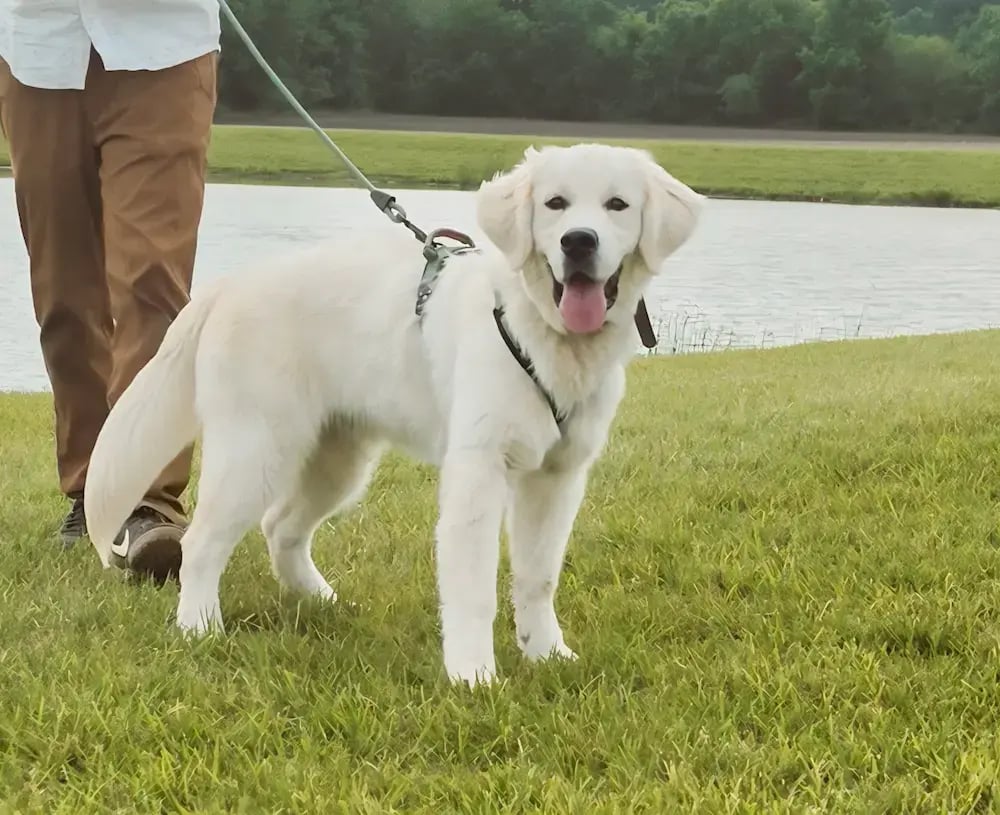
- Use a well-fitted harness or flat collar. A front-clip harness gives you a little extra help on tougher days without any discomfort to your pup. We don't recommend prong, choke, or shock collars — they're unnecessary, and they work against the trusting relationship you're building.
- Keep treats small and exciting. You'll be handing out a lot of them early on, so think tiny.
- Be patient with the puppy brain. A four-month-old simply can't focus the way an adult can. Expect distraction. Reward the wins.
- Quit while you're ahead. A short, happy session beats a long, frustrating one every single time.
The Bigger Picture
Loose-leash walking isn't really about the leash. It's about the relationship — about your Golden learning to look to you, move with you, and trust that staying close is always worth it. That's the same gentle, attentive foundation we lay in our home during your puppy's very first weeks, and it's the same spirit we hope every one of our families carries forward.
Take your time. Keep it kind. And before long, you'll have exactly what you set out for: a walk you both look forward to.
Have questions about raising your Ivory & Pine puppy? We're always here for our families — reach out anytime. We'd love to hear from you.